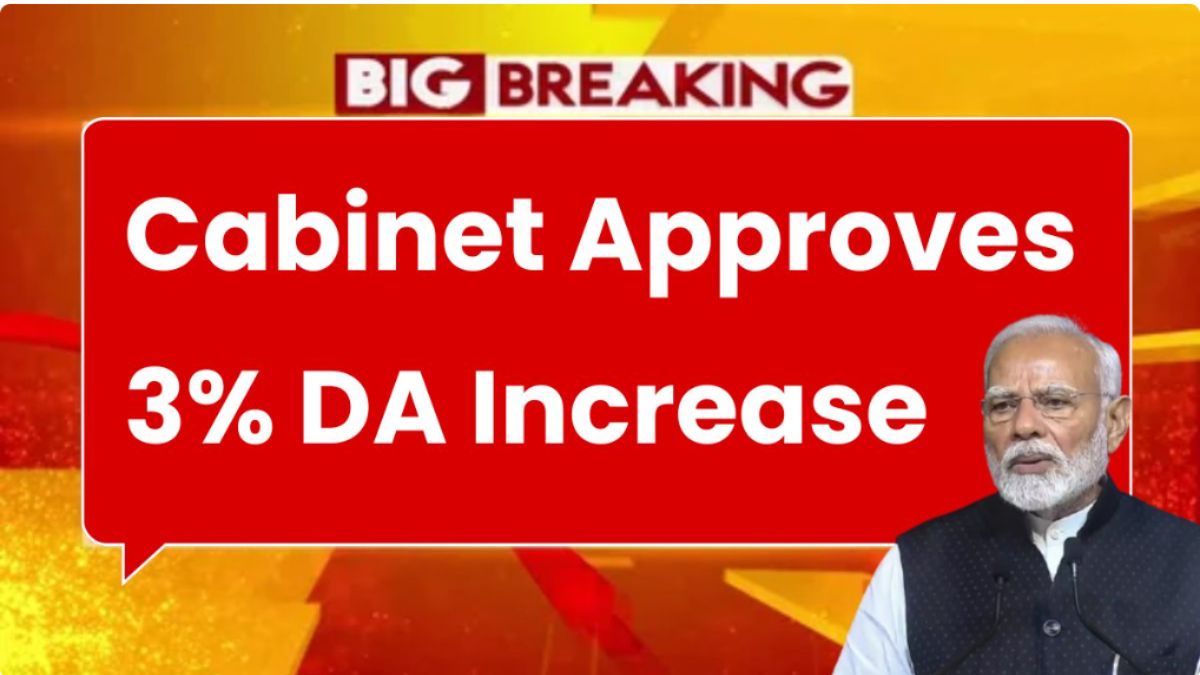
Cabinet Approves 3% DA Increase – India’s Union Cabinet has announced a sweeping package of policy decisions covering a broad range of national priorities — from financial relief for government workers to rural development, food self-sufficiency, education expansion, and infrastructure growth. Here is a detailed breakdown of what was approved and what it means for the people it affects.
Dearness Allowance Raised by 3% for Central Government Employees and Pensioners
More than 1.18 crore people stand to benefit from the government’s latest revision of the Dearness Allowance (DA) and Dearness Relief (DR) — a combined group comprising approximately 49 lakh serving employees and around 69 lakh retired individuals. The enhanced rate will officially come into effect from July 1, 2025, resulting in noticeably higher monthly payouts.
DA is reviewed and updated twice each year, with the revision tied to movements in the Consumer Price Index — a measure that reflects how the prices of everyday necessities are changing over time. This particular increase acknowledges the ongoing financial strain that rising costs of essential goods have placed on households in recent months.
यह भी पढ़े:
 रिटायर्ड कर्मचारियों की पेंशन 7500 रुपये होगी, जानें क्या बदलने वाला है । EPFO Pension Update
For employees across different salary brackets, the revision means a direct boost to monthly earnings. Retired pensioners, many of whom depend heavily on their pension to cover recurring expenses such as medicines and utility bills, will also find some added financial breathing room. With discussions around the upcoming 8th Pay Commission gaining momentum ahead of 2026, this DA hike is widely interpreted as an early signal of more substantial salary restructuring to come.
57 New Kendriya Vidyalayas Sanctioned Across Underserved Regions
The Cabinet has given its nod to the establishment of 57 additional Kendriya Vidyalayas at a total expenditure of ₹5,862 crore. Rather than concentrating these institutions in already well-served urban areas, the expansion has been deliberately targeted at regions that currently lack adequate schooling infrastructure — including aspirational districts, areas historically affected by left-wing extremism, mountainous zones, and states in India’s northeastern corridor.
Of the new schools, 20 are planned for districts that do not yet have a single Kendriya Vidyalaya, while 14 will be set up in districts that have been specially identified for developmental focus. Once operational, these schools are expected to provide learning opportunities to approximately 87,000 students and open up close to 4,600 positions for educators and administrative personnel.

This decision underscores the government’s commitment to bringing standardised, quality education within reach of communities that have historically been left behind — an important step toward narrowing the educational divide between urban and rural India.
Mission Launched to Achieve Self-Sufficiency in Pulse Production
Addressing a long-standing challenge in India’s agricultural landscape, the Cabinet approved a dedicated national mission focused on boosting domestic pulse production. The initiative carries a financial commitment of ₹11,440 crore and will run from 2025–26 through 2030–31, with an ambitious target of raising total pulse output to 350 lakh tonnes — a level that would substantially reduce the country’s dependence on imported lentils and legumes.
The programme is expected to benefit around 2 crore farming families and will deliver support through access to better-performing seed varieties, improved post-harvest storage and handling infrastructure, and agricultural technologies designed to withstand climate variability. The benefits are twofold: farmers gain improved productivity and stronger incomes, while the country as a whole moves closer to ensuring a reliable, domestically sourced supply of protein-rich food for its population.

MSP Hike Announced for Rabi Crop Farmers
Farmers growing Rabi crops have also received good news, with the government revising the Minimum Support Price (MSP) for the 2026–27 marketing season upward across several crops. Safflower cultivators will see the largest gain, with support prices climbing by ₹600 per quintal. Those growing masur (red lentils) will benefit from an increase of ₹300 per quintal, providing stronger income assurance at the time of sale.
The purpose behind these revisions is to protect farmers from unpredictable market swings and to ensure that the money earned from selling crops remains meaningfully higher than the cost of producing them. Higher MSPs are a cornerstone of the government’s approach to keeping rural economies stable and agricultural practices financially sustainable over the long term.
₹6,957 Crore Highway Project to Transform Connectivity in Assam
Rounding out the Cabinet’s agenda was the approval of a major road widening project in Assam. The stretch of National Highway-715 running between Kalibor and Numaligarh — approximately 85 kilometres in length — will be upgraded to a four-lane road at a total investment of ₹6,957 crore. The work will be carried out through the Engineering, Procurement and Construction model.
यह भी पढ़े:
 Yamaha Launches Budget Premium Bike – 155cc Engine with 100 KMPL Mileage Shocks Everyone!
Beyond simply cutting down journey times and improving road safety, the project carries significant strategic value. Assam serves as a critical entry point to several northeastern border states, meaning that better road infrastructure here has wide-ranging implications for trade flows, tourism promotion, and the delivery of essential goods and services to communities in harder-to-reach parts of the region.
The Bigger Picture
Viewed collectively, these Cabinet decisions reflect a considered, multi-sector approach to national development. Immediate relief is being extended to government employees and farmers, while longer-term investments in schools, agricultural self-reliance, and physical infrastructure are being made simultaneously. Together, these measures signal a government intent on addressing today’s pressing needs without losing sight of the structural reforms required for sustained progress tomorrow.